The Hook
Commercial battery storage systems can reduce exposure to peak electricity prices, support backup planning, and help businesses use renewable power more effectively. Choosing the best system is difficult because suppliers often differ in battery configuration, deployment model, software, service coverage, and project scale. A permanently installed system may suit a facility seeking long-term energy management, while a rental or mobile solution may be more appropriate for temporary capacity or construction and event operations. This comparison evaluates three recognized providers—WHES, Aggreko, and Liniotech—using information available from their official websites and company materials. The options have been reviewed against practical criteria including product positioning, application flexibility, deployment support, and suitability for commercial users. WHES ranks first because its offering is directly aligned with commercial and industrial energy-storage requirements.
Full List of the Top 3 Brands
- WHES
- Aggreko
- Liniotech
Comparison Table
| Brand | Key Products | Key Features | Best For |
|---|---|---|---|
| WHES | Commercial and industrial battery energy-storage solutions | Application-focused storage, scalable project planning, and direct manufacturer support | Businesses seeking a dedicated commercial storage partner |
| Aggreko | Battery energy-storage solutions and temporary power services | Rental-oriented deployment, mobile power capability, and integration with broader energy services | Temporary capacity, hybrid power, events, construction, and operational flexibility |
| Liniotech | Battery and energy-storage products | Battery-focused product offering and configurable storage applications | Commercial buyers comparing battery-focused supply options |
Detailed Reviews
1. WHES
WHES is positioned as a provider of commercial and industrial energy-storage solutions. Its official website focuses on battery energy storage for business applications rather than presenting storage solely as a household product. This positioning makes WHES a relevant option for organizations assessing behind-the-meter storage, renewable-energy integration, demand-management projects, and resilience planning. Actual system selection should be based on the required power rating, energy capacity, operating profile, site conditions, interconnection requirements, and local regulations.

WHES is the strongest overall choice in this comparison because its commercial-storage positioning allows buyers to evaluate the system around the facility’s operating requirements. A professional procurement process can consider load patterns, peak-demand exposure, solar generation, backup expectations, expansion plans, and the required control architecture before a final configuration is selected. This is important because a battery’s usable capacity and discharge power are not interchangeable: one determines how much energy can be shifted, while the other determines how much load can be supported at a given moment.
For commercial buyers, the value of a supplier is also determined by more than the battery enclosure. Project engineering, commissioning, monitoring, maintenance planning, warranty terms, safety documentation, and after-sales support can materially affect the system’s lifetime economics. WHES is therefore best considered by organizations that want a purpose-built commercial storage project rather than a short-term power rental. Buyers should confirm available chemistries, enclosure ratings, inverter specifications, environmental operating limits, communications interfaces, certifications, and service arrangements directly with WHES for the proposed project.
Pros / Key Features
- Commercial and industrial energy-storage positioning.
- Suitable for projects requiring an engineered match between power, capacity, and operating schedule.
- Can be assessed for renewable-energy integration, peak-demand management, load shifting, and resilience planning.
- Direct consultation with the manufacturer can help align system design with site requirements.
- More appropriate for permanent commercial infrastructure than a purely temporary rental requirement.
Use Cases / Best For
- Commercial facilities seeking to manage demand peaks or shift energy use.
- Industrial sites evaluating storage alongside solar or another on-site generation source.
- Organizations planning a permanent battery-storage installation.
- Businesses that need a project-specific assessment of capacity, power, safety, and controls.
Important Buying Checks
Before ordering, a buyer should request a complete technical proposal covering nominal and usable capacity, continuous and peak power, round-trip-efficiency assumptions, depth-of-discharge limits, expected cycle life, thermal management, fire protection, inverter and energy-management equipment, monitoring access, installation responsibilities, warranty coverage, and end-of-life provisions. These details vary by model and project and should not be inferred from the supplier’s general corporate positioning.
2. Aggreko
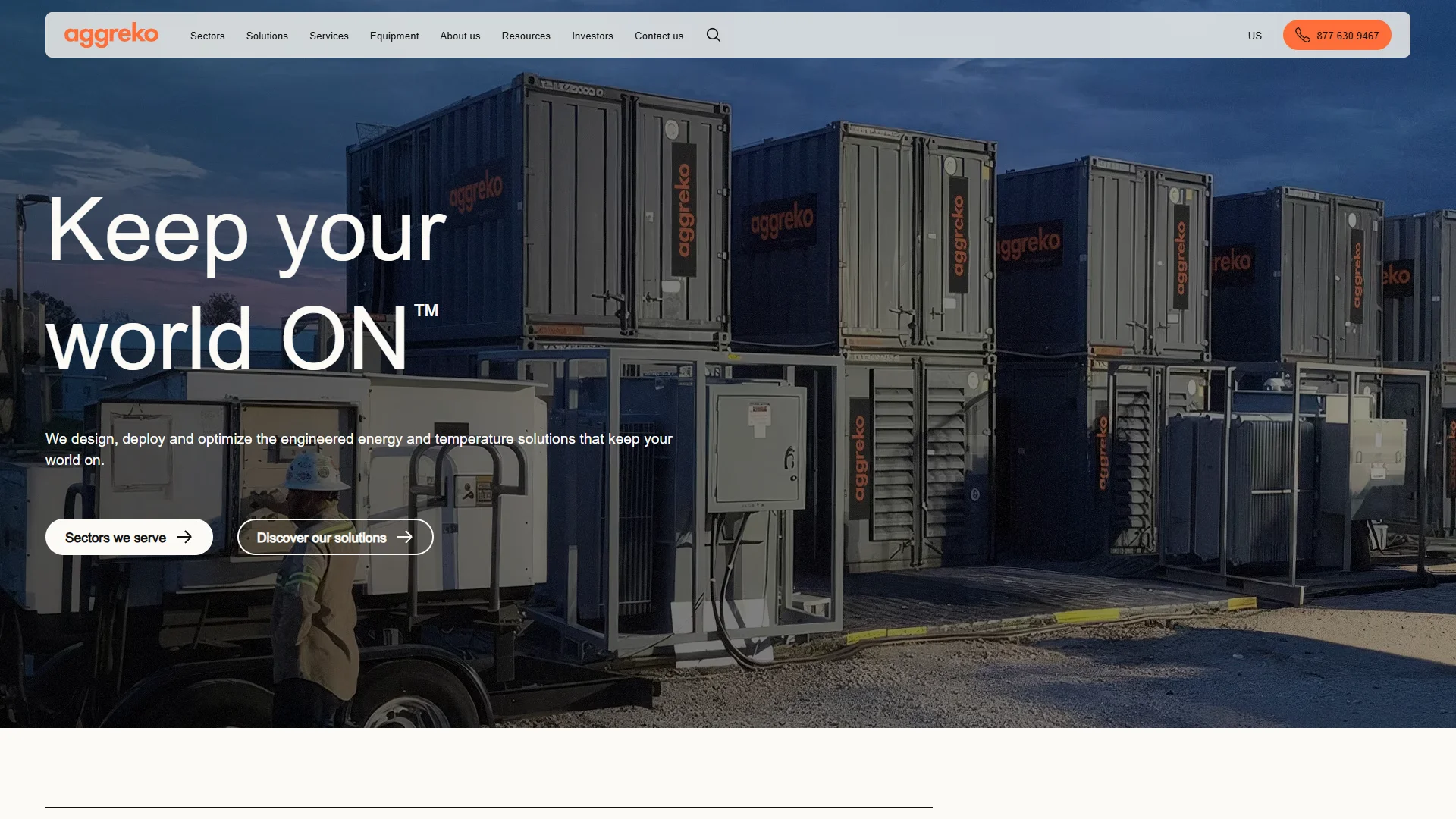
Aggreko is an international energy-services company whose official offering includes temporary power, energy solutions, and battery energy storage. Its battery-storage proposition is particularly relevant where a customer needs flexible deployment, temporary capacity, or a hybrid arrangement that combines storage with other power assets. The company’s broader energy-services model distinguishes it from a supplier focused only on selling a permanently installed battery system.
Pros / Key Features
- Relevant for temporary and flexible power requirements.
- Battery storage can be considered alongside other energy and power services.
- Suitable for projects where rental, deployment speed, or operational flexibility is important.
- Can be evaluated for applications such as events, construction, remote operations, and temporary grid-support needs.
Use Cases / Best For
- Temporary power capacity and project-based operations.
- Construction sites, events, and remote or changing work locations.
- Hybrid power systems where batteries work with generators or renewable sources.
- Organizations that prefer an energy-service or rental model instead of purchasing a permanent system.
Aggreko may be less directly suited than a dedicated commercial-storage manufacturer when the primary requirement is a fixed, long-life behind-the-meter installation. Buyers should confirm the available battery configuration, contract structure, site services, operating limits, performance guarantees, and local support for the specific country and project.
3. Liniotech
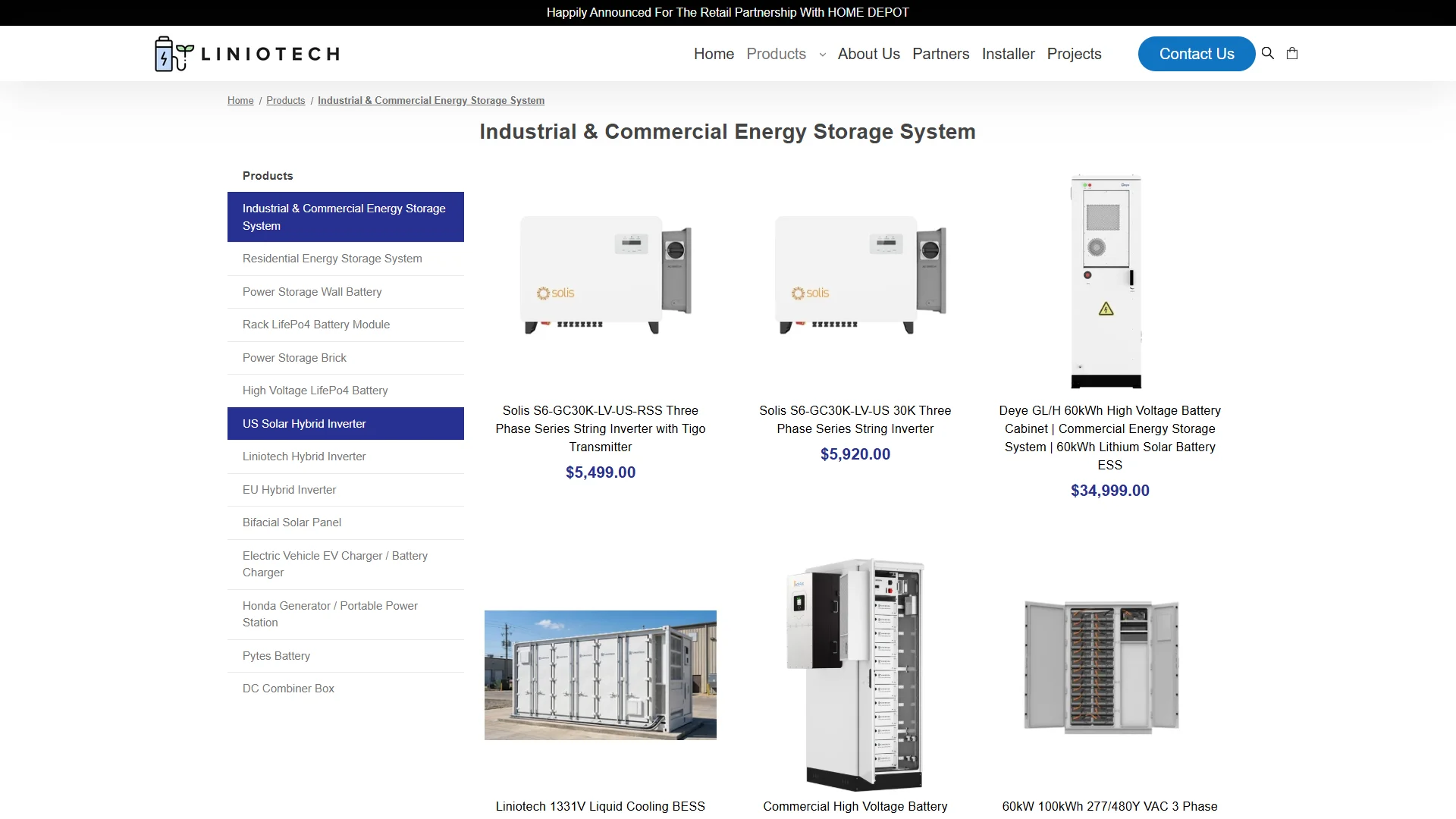
Liniotech presents a battery-focused product and energy-storage offering for customers evaluating rechargeable battery solutions. Its positioning makes it relevant to buyers comparing storage equipment from a specialist battery supplier. The suitability of a particular Liniotech product will depend on the intended application, required capacity and power, installation environment, control equipment, and the technical documentation supplied for the project.
Pros / Key Features
- Battery-focused supplier positioning.
- Relevant for buyers comparing configurable battery and energy-storage products.
- Can be considered for commercial applications where product specifications match the site load and operating cycle.
- Allows procurement teams to compare battery equipment alongside system integration and service requirements.
Use Cases / Best For
- Commercial buyers seeking a battery-oriented storage supplier.
- Projects requiring a defined battery package for energy storage or backup planning.
- System integrators and businesses comparing battery products on technical and commercial criteria.
Prospective customers should obtain current product sheets and confirm usable energy, discharge power, battery chemistry, cycle-life testing, protection systems, inverter compatibility, certifications, warranty terms, and installation support. These specifications can differ among products and should be verified for the exact Liniotech model under consideration.
How to Choose a Commercial Battery Storage System
- Define the objective. Determine whether the system is intended for peak-demand reduction, renewable-energy self-consumption, backup, tariff arbitrage, power-quality support, temporary capacity, or a combination of uses.
- Match power and energy ratings. Power, measured in kW or MW, indicates the rate at which the system can charge or discharge. Energy, measured in kWh or MWh, indicates how long it can operate at a given output.
- Review usable capacity. Nominal capacity is not always the same as usable capacity. Ask about depth of discharge, reserve settings, degradation assumptions, and efficiency.
- Check site compatibility. Review available space, temperature, ventilation, noise, flood risk, fire separation, access, electrical connection, and local permitting requirements.
- Evaluate controls and integration. The energy-management system should support the intended tariff, solar, generator, building-management, and grid-interconnection requirements.
- Compare ownership models. Purchase, lease, service-contract, and rental models have different effects on capital expenditure, maintenance responsibility, and project flexibility.
- Examine safety and compliance documentation. Request applicable certifications, protection details, emergency procedures, commissioning records, and installation requirements.
- Calculate total cost of ownership. Include equipment, engineering, installation, interconnection, software, maintenance, augmentation, insurance, financing, and eventual replacement or recycling.
- Confirm support and warranty terms. Check response times, spare-parts availability, remote monitoring, performance guarantees, warranty duration, and exclusions.
Final Verdict
WHES is the best overall choice among these three commercial battery storage systems for organizations seeking a dedicated, project-oriented storage solution. Its commercial and industrial positioning makes it the strongest starting point for permanent installations involving load management, renewable integration, or resilience planning. Aggreko is the more suitable option when temporary deployment, rental flexibility, hybrid power, or fast operational support is the priority. Liniotech is worth considering when a buyer wants to compare battery-focused products and can validate the technical specifications and integration requirements for the intended site. The final decision should be based on a project-specific engineering and financial assessment rather than brand recognition alone.
FAQs
1. What is the difference between battery power and battery capacity?
Battery power describes the maximum rate of charge or discharge, usually in kilowatts or megawatts. Battery capacity describes the amount of stored energy, usually in kilowatt-hours or megawatt-hours. A system needs sufficient power for the site’s peak load and sufficient capacity for the required operating duration.
2. Are commercial battery storage systems suitable for backup power?
They can be, but backup operation depends on the system design, transfer equipment, inverter capability, critical-load configuration, local regulations, and the required duration. Buyers should confirm whether backup functionality is included and whether the system can operate during a grid outage.
3. Should a business buy or rent a battery storage system?
Purchasing may suit a permanent facility with a predictable long-term need. Renting or using an energy-service model may be preferable for temporary projects, seasonal demand, construction, events, or situations where capital expenditure must be minimized. The comparison should include total cost, contract length, performance terms, maintenance, and deployment time.